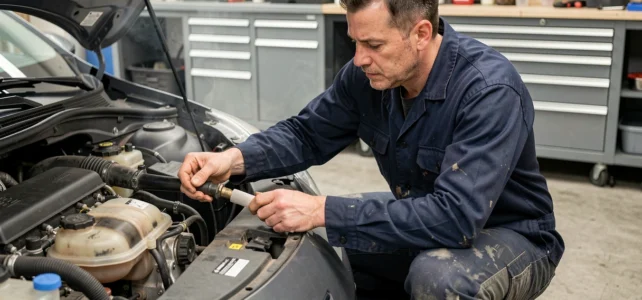
On the 1.6 HDi and 2.0 HDi engines of the Peugeot 308, a fuel system priming issue mainly occurs after running out of fuel, replacing the diesel filter, or performing work on the low-pressure line. The priming procedure varies depending on the engine generation and vehicle equipment, and certain technical nuances make the difference between a quick restart and persistent cranking that can damage the high-pressure pump.
Priming with a diagnostic tool on 308 HDi: the workshop method
On recent HDi engines, particularly the BlueHDi Euro 6 derivatives, the most reliable method to prime the system involves using a diagnostic tool. The tool directly controls the fuel pump relay, opens the necessary solenoid valves, and initiates a filling sequence of the system without engaging the starter.
This approach has a major advantage: it avoids running the starter for long seconds, which protects both the battery and high-pressure components. On a completely empty system, prolonged cranking can cause the high-pressure pump to run dry, accelerating its internal wear.
We recommend this method as soon as a compatible tool is available (Diagbox, Lexia, or equivalent multi-brand with PSA coverage). The service mode activates the fuel pump for a controlled duration, purges air from the low-pressure system, and fills the fuel filter before any compression cycle. If you are looking to prime the fuel system of a 308 HDi without diagnostic equipment, the manual methods detailed below remain effective but require more precision.
Priming bulb on 308 1.6 HDi: location and pumping technique
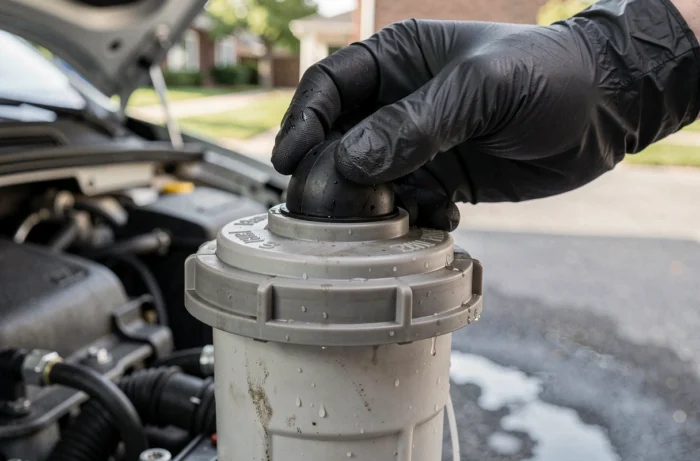
The priming bulb on the 1.6 HDi 90 and 110 hp is located on the fuel filter support, usually on the left side of the engine compartment. In some versions, its location differs from what the user manual indicates, which confuses many owners.
Purge sequence with the bulb
Before pumping, unscrew the air bleed screw of the filter a quarter turn. Place a cloth or container under this screw to catch the diesel that will flow out. Then, pump the bulb steadily, without violent jolts.
The criterion for success is simple: the diesel that comes out at the bleed screw should no longer contain air bubbles. As long as bubbles appear, continue pumping. Once a continuous and bubble-free flow is obtained, tighten the bleed screw and then pump the bulb again until you feel a firm resistance.
- Bleed screw: only a quarter turn, no complete unscrewing to avoid losing the seal
- Pumping: regular sequences of firm presses, hold the bulb down for a second before releasing
- Validation: bubble-free diesel at the bleed screw before attempting to start
- After tightening: turn the ignition on without starting (position 2) for about ten seconds to activate the electric fuel pump, then start the engine
Priming a 308 HDi without a bulb: the contact cycle technique
Some versions of the 308 HDi do not have an accessible priming bulb. This is the case for several 2.0 HDi models and some vintages where the system is entirely managed by the submerged electric fuel pump in the tank.
The procedure relies on repeated contact cycles without starting. Turn the key to position 2 (dashboard lit, warning lights active) and hold this position for about ten seconds. You should hear the humming of the fuel pump working. Turn off the ignition, wait a few seconds, and then repeat.
We find that it generally takes between five and ten cycles for a completely empty system to fill sufficiently. After these cycles, attempt a brief start. If the engine coughs without starting, do not persist beyond five seconds: turn off and resume the contact cycles.
Common pitfall: starter engaged too long
Insisting on the starter for more than ten seconds in a system still full of air is a costly mistake. The high-pressure pump, designed to operate lubricated by diesel, runs without lubrication. On the piezoelectric injectors of recent HDi engines, running dry can cause partial seizing, which represents a significant repair cost.
Causes of persistent priming issues on HDi systems
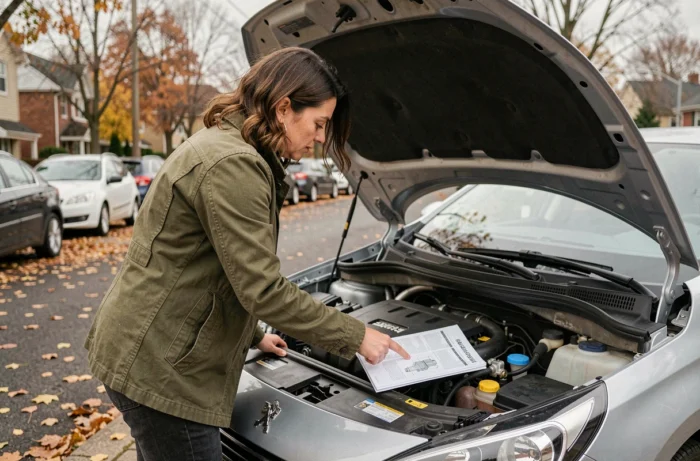
If priming fails despite a correct procedure, the problem rarely lies with the technique used. Several mechanical causes prevent the system from maintaining its fuel charge.
- Air intake on a connection in the low-pressure line, often at the hoses between the filter and the fuel pump. A cracked fitting or a loose clamp is enough to continuously draw in air
- Defective fuel filter support seal after a filter replacement, especially if the O-ring was not changed or was improperly positioned
- Non-functional check valve of the fuel pump: the system empties as soon as the engine stops, making every cold start laborious
On a 1.6 HDi that consistently loses prime after a night of parking, we direct the diagnosis towards the check valve or an air intake on the suction side. A vacuum check on the low-pressure line, performed with a manual vacuum pump, allows for quick identification of the faulty section.
Priming an HDi fuel system remains an accessible operation as long as the air purge sequence is followed and the high-pressure pump is protected. On vehicles equipped with diagnostic connectors, the forced activation of the fuel pump via a diagnostic tool remains the safest and quickest method to recharge the system without risk to the injection components.