
The power bench test remains a niche service, often associated with sports cars or reprogrammed vehicles. Its price varies depending on the providers, the type of bench, and additional services. But beyond the cost, the real value of a measurement on the bench depends on what can be read from the results sheet and what the bench cannot measure.
What a roller bench actually measures (and what it does not measure)
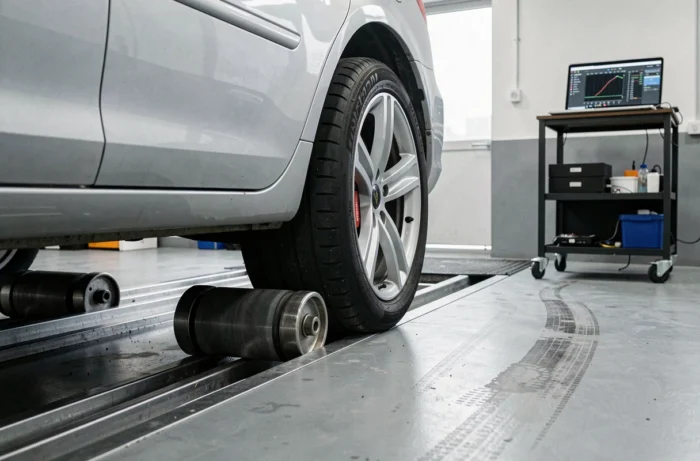
An automotive power bench does not directly measure the engine’s power. The rollers capture the effort transmitted at the tire level, after losses related to the transmission, gearbox, and wheel shafts. The value obtained is therefore a wheel power, not a raw engine power.
To estimate engine power, the bench software applies correction coefficients. These corrections take into account ambient temperature, atmospheric pressure, and humidity. Depending on the standard used (DIN, SAE, STD), the results can vary significantly for the same vehicle tested on the same day.
A reliable results sheet indicates the correction standard applied, the atmospheric conditions at the time of the test, and the level of curve smoothing. Without this information, comparing two bench tests makes no technical sense. A gain of a few horsepower between two sessions may simply reflect a difference in outside temperature.
The bench also does not replicate real driving conditions. Wind, slope, vehicle load, and variations in grip on the road are absent from the test. Some workshops supplement the session with real-time data collection (boost pressure, fuel pressure, temperatures) and then check these parameters during a road test. To better understand the car bench test, Miss Deux Roues details the steps and rates applied.

Cost of a bench test: price variations and what explains them
The lowest rates start around 49 to 69 euros including tax for a simple test on a two-wheel drive bench. This price corresponds to one or two runs with a power and torque curve provided.
Several factors influence the final bill:
- The type of bench used: a four-wheel drive bench, necessary for all-wheel drive vehicles, is more expensive to operate and maintain. The price reflects this.
- Additional services: reading fault codes via the OBD port, measuring boost pressures, exhaust temperatures, or diagnosing the engine control unit (ECU) increases the time spent on the vehicle.
- Group sessions: some providers offer discounted rates during dedicated days. Prices can drop significantly when multiple vehicles are tested in the same session.
A bench test alone, without reprogramming or modification, remains a relatively accessible service. However, when it is part of a package that includes a custom engine mapping, the overall price rises well beyond the simple test.
Simple test or complete diagnosis
A quick bench test is sufficient to obtain a power curve and verify that a vehicle delivers what it should. But this curve says nothing about the condition of the injectors, the load of the particulate filter, or turbo wear.
A thorough engine diagnosis before the bench test helps identify anomalies that could skew the measurement. A worn turbo or a partially blocked intake will produce a disappointing curve, without the bench alone explaining the cause.
Engine reprogramming and bench test: what the law requires
The bench test is often used to validate the gains from engine reprogramming, whether it is a stage 1 or an E85 conversion. The before/after measurement provides a quantified proof of the result. However, this technical proof does not equate to regulatory compliance.
The DREAL Auvergne-Rhône-Alpes reminds us that reprogramming is only possible in certain specific cases that correspond to a transformation compatible with the vehicle’s original approval. A modification of the ECU mapping that alters the characteristics listed on the registration certificate (taxable power, emissions) can lead to a refusal at the technical inspection or cause problems in the event of an accident.
The question of insurance is equally concrete. Some contracts exclude mechanical damage on a vehicle whose engine has been reprogrammed without prior declaration. The bench test proves that the power has changed, but it does not constitute homologation and does not protect the owner in case of a dispute.
When a bench test is truly worth its price
For a stock vehicle that has never been modified, the bench test is more about curiosity than necessity. Manufacturer data provides a sufficient approximation for everyday use.
The measurement becomes particularly relevant in specific situations:
- After reprogramming or the installation of performance parts (turbo, intake, exhaust), to verify the actual gains compared to the claimed values.
- When purchasing a used sports vehicle, to ensure that the engine still delivers its original power, or to detect an undeclared reprogramming.
- In case of perceived power loss, to objectify the problem before incurring repair costs.
In each of these cases, the cost of the bench test remains marginal compared to the sums at stake, whether it is a reprogramming billed at several hundred euros or the purchase of a used vehicle.
The power bench remains a measurement tool, not a certificate. Its value depends on the technician’s expertise, the rigor of the protocol, and the ability to cross-reference bench data with a complete engine diagnosis. A power figure without context is worth little. A well-interpreted curve, combined with a recording of engine parameters, can prevent a costly mistake.