
When you hear a dull noise under the car or spot a rust mark on a pipe, the first challenge is not finding the spare part. It’s knowing which one to replace. The car exhaust system consists of several components in series, and confusing an intermediate pipe with a turbo downpipe means ordering the wrong part number, wasting time, and sometimes worsening the problem.
Reading an exploded view of the exhaust without getting the reference wrong
In an online catalog or technical manual, the exhaust system appears as an exploded view. Each part has a number linked to a legend. The natural reflex is to look for the name of the part you think is faulty, but you save time by starting from the engine and moving towards the back of the vehicle.
The reading direction is always the same: manifold, catalytic converter (or turbo downpipe on a diesel), intermediate pipe, front silencer, rear silencer, tailpipe. By following this path on the car exhaust diagram, you can quickly identify where the worn component is located.
A common mistake: confusing the front silencer (often called “pre-silencer”) with the rear silencer. In the exploded view, the pre-silencer is located just after the catalytic converter, while the rear silencer is the last visible component under the bumper. Their shapes are sometimes similar, but their fittings and diameters differ.
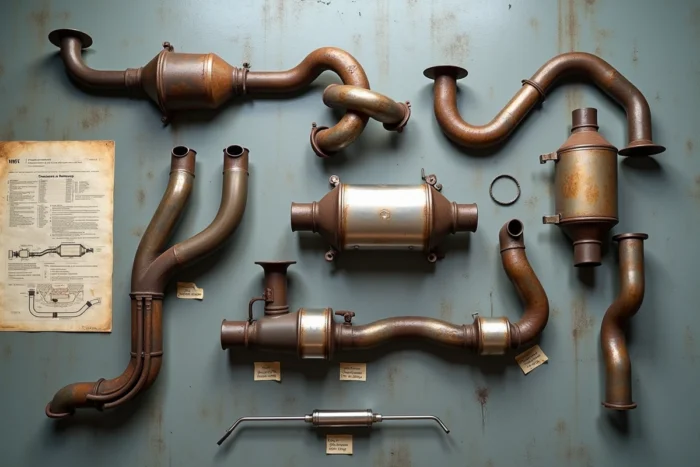
Manifold and catalytic converter: the hot zone of the exhaust system
The exhaust manifold collects burnt gases directly from the cylinder head. On a four-cylinder engine, you can see four pipes converging into a single outlet. This part endures the highest temperatures of the entire system, which is why it is made of cast iron or thick molded steel.
Just downstream, the catalytic converter (or catalytic pot) transforms some of the pollutants using precious metals like platinum or palladium deposited on a ceramic or metallic substrate. On recent gasoline engines, a gasoline particulate filter (GPF) is added after the catalytic converter. Many outdated diagrams do not show this filter, which can lead to confusion when searching for the correct part number for a recent vehicle.
Diesel engine: an additional part to identify
On a diesel, the particulate filter (DPF) has been present for longer. It is usually placed between the oxidation catalytic converter and the front silencer. When looking at the exploded view, you can identify the DPF by its bulky casing and the differential pressure sensors connected to it.
If the vehicle consumes more than usual or if a check engine light comes on, the problem often comes from a clogged DPF, not the silencer. Locating this part on the diagram before ordering prevents unnecessary expenses.
Intermediate pipes and gaskets: the parts often overlooked on the diagram
Between the major components (catalytic converter, silencers), pipes connect everything. They may seem insignificant, but they are the ones that rust first, especially in regions where de-icing salt attacks the undercarriage. On the exploded view, they can be identified by the numbers located between two main parts.
The connection gaskets and clamps deserve equal attention. A faulty exhaust gasket causes a loud gas leak, often mistaken for a perforated silencer. Here are the connecting elements to check on the diagram:
- The flange gaskets between the manifold and the catalytic converter, often made of corrugated metal or graphite, which compress with repeated thermal cycles.
- The clamps (band or bolt type) that hold the pipes together, visible on the exploded view as small ring-like pieces.
- The rubber exhaust hangers or supports, attached to the chassis, which absorb vibrations and prevent the system from touching the floor.
A broken hanger allows the system to sag and vibrate, which accelerates the fatigue of the welds and gaskets. These supports can be identified on the diagram by the small hooks drawn above the system.

Rear silencer and tailpipe: identifying the correct part number
The rear silencer is the most commonly replaced part because it is the most exposed to water and mud splashes. On the diagram, it is the widest component located at the end of the system, just before the tailpipe.
Feedback varies on this point, but the most common confusion concerns vehicles equipped with a dual rear silencer (one on each side). Some catalogs list the left and right parts under different references, even if they appear identical to the naked eye. Checking the side (left or right) on the exploded view before ordering prevents a part return.
Performance exhaust systems from the manufacturer
Several manufacturers now offer “Performance” exhaust systems installed at the factory, with larger diameter stainless steel pipes and specific outlets. In these configurations, the standard diagram for the base model no longer applies. You need to search for the exploded view corresponding to the exact trim level of the vehicle, often identified by an option code in the service booklet.
Quick method to cross-reference the diagram with the physical part
Once you have the diagram in front of you, go under the car (cold engine, vehicle on jack stands). The most reliable method to avoid mistakes:
- Start from the manifold, visible on the engine side, and follow the system towards the back while counting each connection.
- Compare the number of visible silencers under the vehicle with those shown on the exploded view.
- Measure the diameter of the pipe at the suspected connection point (a simple caliper will suffice) and compare it to the technical sheet of the replacement part.
- Photograph the entire setup before disassembly to note the orientation of the clamps and the position of the rubber supports.
Each visible connection under the car corresponds to a number on the diagram. By counting the junctions from the engine, you can precisely identify the area to address without disassembling the entire system.
One last often-overlooked point: the sensors. The lambda sensor (or oxygen sensor) is connected to the catalytic converter or just upstream. On the diagram, it appears as a small threaded connector. Accidentally disconnecting it while replacing a pipe triggers a check engine fault. Identifying its position on the exploded view before touching anything remains the most time-efficient action.