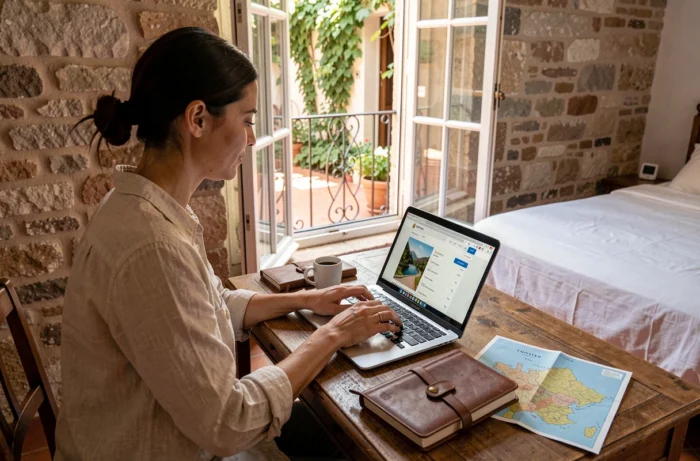
Book a gîte in the Luberon for a long weekend and find yourself twenty minutes by car from the nearest shop, without a washing machine and with a spotty Wi-Fi connection: many have experienced this disconnect. The choice of accommodation in France determines the pace of the trip, the daily budget, and even the desire to return to a region. Rather than listing the obvious, we will focus on the points that truly make a difference in a stay.
Registration number and compliance: what to check before booking
Since May 20, 2026, short-term rentals must display a national registration number on each listing. This number, issued through a dedicated online service, applies to both platforms like Airbnb and Booking.com as well as owners who market their property directly.
In practice, we check if this number is included in the listing. Its absence indicates either an administrative oversight or an undeclared property. In either case, we are taking a risk: an owner who does not comply with this requirement is unlikely to adhere to safety or cleanliness standards.
The Le Meur law, adopted on November 19, 2024, has also allowed municipalities to reduce the maximum rental duration of a primary residence in furnished tourism from 120 to 90 days. Major cities and tourist areas often apply this reduced cap. If we book an apartment for a long stay during peak season, it’s best to verify that the owner hasn’t already exhausted their quota of days. A last-minute cancellation for non-compliance can happen.
When comparing search results across multiple platforms, filtering by accommodation on Voyages 365 allows us to cross-reference offers with specific compliance and location criteria, saving time on this verification.

Furnished tourism or tourist residence: a distinction that changes the guarantees
People often confuse the two, and this is a costly mistake in terms of comfort. A furnished tourism property is an individual accommodation rented by a private individual or a professional. The new registration and duration limitation rules apply directly to it.
A tourist residence, on the other hand, is a commercial establishment. It offers furnished accommodations with shared services (reception, cleaning, sometimes catering). The regulatory constraints are not the same, and neither are the guarantees: in a residence, you generally benefit from an on-site contact and a more structured contractual framework.
For a family stay with young children, a tourist residence often provides a reassuring safety net. For a couple seeking the authenticity of a Provençal village, an individual furnished property remains the right choice, provided that the compliance of the accommodation has been verified.
Location of accommodation in France: beyond the postal code
Competitors all talk about “checking the location.” We will be more precise. The real question is not “is it in Brittany or Provence,” but how many minutes away are the three points of interest for the stay.
Calculate the actual travel time, not the distance
In rural France, ten kilometers can represent twenty-five minutes of winding road. Before booking, we plot the route on a navigation app between the accommodation and the places we plan to visit. We do this on a Tuesday at 9 AM to get an estimate without traffic, then we add a buffer for market days or peak season.
Proximity to shops and basic services
An accommodation “in a quiet area” could mean fifteen minutes from the nearest bakery. For a road trip with several short stops, this is not an issue. For a week-long stay in the same place, it changes daily life. We check on the map:
- The distance to the nearest supermarket or grocery store, in driving minutes and not just kilometers
- The presence of a pharmacy and a medical office within a reasonable radius, especially with children
- Access to a train station or bus stop if we do not have a car on site

Accommodation price and actual costs: compare what is comparable
The price displayed on a booking platform is almost never the final price. Cleaning fees, tourist tax, security deposit, and sometimes bed linen charges can significantly increase the total cost.
Our method: we note the total price for the exact duration of the stay, all fees included, and then divide by the number of nights. This is the only figure that allows for a fair comparison between a hotel, a gîte, and a tourist residence.
- Hotels generally include cleaning and linen, but charge extra for breakfast, sometimes at a high rate
- Furnished tourism properties often display an attractive price per night, to which fixed cleaning fees are added, which weigh more heavily on short stays
- Tourist residences sometimes offer weekly packages with included services, which are more advantageous than booking by the night
Feedback varies on this point, but it is often observed that a two or three-night stay in a furnished property can end up being more expensive per night than in a hotel once cleaning fees are factored in. Beyond five nights, the ratio reverses.
Traveler reviews and photos: reading between the lines
The photos in the listing show the accommodation in its best light, often with a wide-angle lens that enlarges the rooms. Instead, we look for photos posted by travelers in their reviews: they provide a more reliable idea of the space and the actual condition of the property.
Regarding the reviews themselves, we ignore extreme ratings (5-star rave reviews, 1-star vengeful ones) and focus on 3 or 4-star reviews. These are the ones that detail the strengths and concrete limitations: noise at night, water pressure, quality of bedding, responsiveness of the owner.
A property with few recent reviews also deserves caution. A furnished property that hasn’t received any comments for several months may have changed owners, managers, or simply standards.
Finding the right accommodation in France does not require hours of comparison, but rather a few targeted verification reflexes. The registration number, the distinction between types of accommodation, the calculation of the actual cost per night, and a critical reading of reviews form an effective filter. The rest is a matter of taste and destination.