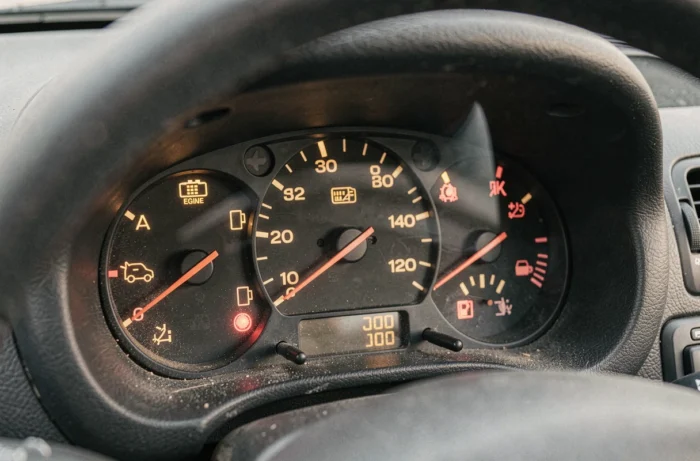
The Peugeot 206 remains one of the most common city cars on French roads. Its dashboard, designed in the late 1990s, features about fifteen warning lights, the logic of which is far from intuitive. Several generations of instrument clusters have coexisted depending on the model year and trim levels, which further complicates the reading of alerts.
Self-check at startup: what the cluster checks before you
Before detailing each warning light, it’s important to understand what happens in the first few seconds after turning on the ignition. All the lights briefly illuminate for a bulb test. This self-check phase confirms that each light is functioning physically.
A light that does not illuminate at all during this test is likely burnt out. You then lose all detection capability for the circuit it monitors, without any warning signal. On an older car, checking that all lights participate in this startup test is a safety reflex that is often overlooked.
A light that stays on after the engine starts indicates a real fault. The nuance is there: a brief illumination is normal, but persistence is not. Field reports show that many 206 drivers eventually ignore a permanent light, especially if it is orange, assuming it is a faulty connection. This habit can mask a mechanical or electrical problem that silently worsens.
To accurately identify each symbol present on your cluster, the list of dashboard warning lights for the Peugeot 206 details their meanings according to the engine type and model year.
Red warning lights on Peugeot 206: immediate stop or quick diagnosis
Red always signifies a priority alert. On the 206, several red lights coexist, and their severity is not the same.
STOP light and oil pressure
The STOP light usually accompanies another red light to emphasize urgency. When associated with the oil can symbol, it indicates a drop in engine oil pressure. Continuing to drive in this situation can cause engine seizure within a few kilometers.
The correct reflex is to turn off the engine as soon as possible, check the oil level when cold, and not restart if the level is correct but the light persists. The problem may stem from the oil pump, the pressure sensor, or a leak.
Coolant temperature
The red thermometer signals overheating. On the 206, especially the HDi versions, the cooling system ages poorly: stiffened hoses, stuck thermostat, broken fan. Ignoring overheating for a few minutes is enough to warp the cylinder head.
When this light comes on while driving, turning off the air conditioning, setting the heater to maximum (to dissipate heat from the system), and stopping quickly is the recommended procedure.
Battery charge light
The red battery symbol while driving does not refer to the battery itself but indicates a charging fault. The alternator is no longer supplying current. The vehicle runs on the battery’s reserve, which will deplete in a few tens of minutes depending on active consumers (headlights, ventilation, defrosting).
Orange warning lights on the 206 dashboard: monitor without panic
The orange lights on the 206 signal anomalies that do not require an immediate stop but necessitate diagnosis in the following days.
The most common is the engine warning light (MIL), represented by a stylized engine pictogram. On the 206 HDi and fuel-injected versions, it lights up when the ECU detects a fault in engine management. Causes range from a simple faulty air temperature sensor to a clogged EGR valve.
Field reports vary on this point: some drivers drive for months with this light on without apparent consequences, while others notice increased fuel consumption or a switch to limp mode. Only reading the fault codes with an OBD diagnostic tool can clarify the situation.
- Pollution warning light (orange engine): OBD diagnosis required, no urgent stop unless marked loss of power
- ABS light: conventional braking remains operational, but the anti-lock system is disabled, which increases braking distances on slippery surfaces
- ESP or anti-skid light: electronic stability no longer corrects trajectories, increased caution in turns and on wet surfaces
- Preheating light (diesel): normal at startup, abnormal if it flashes while driving, often related to an injection issue

Multiple warning lights on at the same time: electrical issues first
A common phenomenon on high-mileage 206s is the simultaneous illumination of several lights with no apparent relation between them. The ABS light, engine light, and power steering light may all illuminate together after a difficult start.
This scenario often points to an electrical supply fault rather than multiple independent failures. A weak battery, oxidized terminals, or an aging alternator can cause micro-cuts in voltage. The instrument cluster and ECUs interpret these variations as faults in their respective circuits.
Before replacing an ABS sensor or lambda probe based on a warning light, checking the battery condition and measuring the alternator charge voltage (with a simple multimeter) can eliminate the most likely and least costly cause. On a car of this age, the ground connections on the engine block and body also deserve visual inspection: a corroded ground point reproduces exactly the same symptoms.
Resetting the maintenance indicator on the 206
The 206 has a maintenance light (wrench) that illuminates at programmed intervals. The reset procedure differs depending on the type of cluster installed. The early versions use a single trip button, while the more recent multiplexed versions require a different button combination.
Applying the wrong procedure resets nothing and may even delay the next reminder. The model year and engine type (gasoline or HDi) determine the applicable method. Consulting the manual specific to your version remains the most reliable way to avoid unnecessary manipulation.
The reliability of the 206’s dashboard depends as much on the state of the electrical circuit as on the mechanics monitored by each sensor. A warning light rarely tells the whole story: it indicates where to look, not what to replace.