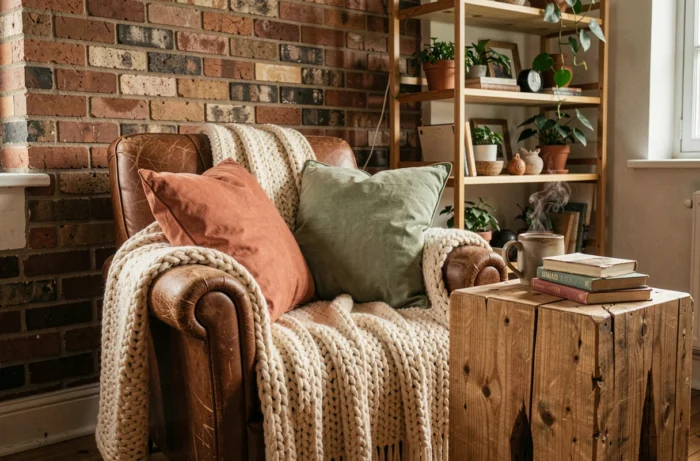
A soft sofa, three candles, and a throw blanket are not enough to make a room truly comfortable. You realize this as soon as you spend an evening in a poorly ventilated or overheated living room in the summer: the cozy cocoon promised by magazines falls flat. Transforming your home into a space where you feel good requires working on less visible parameters than the color of the cushions.
Indoor air quality: the invisible comfort of a warm cocoon
We often think of decor, rarely of ambient air. A closed, heated interior furnished with cheap particle board can emit formaldehyde and other volatile organic compounds. French regulations have set a guideline value of 10 µg/m³ for formaldehyde in indoor air since January 1, 2023. This is a low threshold, and many older homes exceed it without the occupants being aware.
General and permanent ventilation is also a regulatory obligation, governed by the decree of March 24, 1982. Whether natural or mechanical, it directly affects the feeling of well-being. A living room with soft materials but stale air causes fatigue, headaches, and general discomfort. Concrete solutions can be found on www.pendantcetemps.net to balance layout and actual livability.
Before choosing a piece of furniture or a covering, checking its labeling (class A+ for VOC emissions) changes the game. It’s not a glamorous reflex, but a healthy interior is the foundation of a true cocoon.

Light and temperature: two levers that decoration alone cannot solve
Soft lighting remains a classic for creating a cozy atmosphere. We layer light sources (table lamp, string lights, wall sconce) instead of relying on a single ceiling fixture. So far, nothing new.
What we often forget is natural light. A south-facing living room without sun protection becomes unlivable by June. The RE2020, which came into effect in 2022, includes an indicator of degree-hours of discomfort to limit overheating in new homes. The goal is to reduce the systematic reliance on air conditioning.
In existing spaces, a few simple interventions can change the experience:
- Thick linen curtains or lined sheers filter summer heat without plunging the room into darkness.
- A reversible ceiling fan circulates warm air in winter and cools in summer, at a low energy cost.
- A wool rug placed on cold tiles cuts the sensation of a cold floor, especially in older homes.
The warm ambiance of a room depends as much on the perceived temperature as on the color palette. Addressing thermal comfort before decorating prevents compensating for insulation issues with layers of throws.
Materials and furniture: choose based on the actual use of each room
Competitors often list materials by aesthetics: wood, rattan, velvet, boucle. We prefer to reason by usage constraints. A living room traversed ten times a day by children and a dog has different needs than a quiet office.
High-traffic family living room
Opt for removable and machine-washable fabrics. Short-pile corduroy withstands claws better than plush velvet. For cushions, twill cotton covers last for several years. A non-removable sofa in a family living room is a common mistake that is regretted as soon as winter arrives.
Solid wood (oak, beech) withstands impacts better than veneer. If the budget is tight, a high-pressure laminate top offers an acceptable compromise, provided the VOC labeling mentioned earlier is checked.
Bedroom or reading nook
You can afford more delicate materials: crumpled linen, mohair, felted wool. A well-padded armchair with a deep seat and a footrest transforms a dead corner into a true refuge. The choice of foam density matters more than the fabric color: below a sufficient density, the seat collapses within months.
Warm colors and wall decoration: anchoring the ambiance without overloading
Neutral palettes (beige, ecru, greige) have dominated cozy interiors for several seasons. They work, but you can go further without falling into excess.
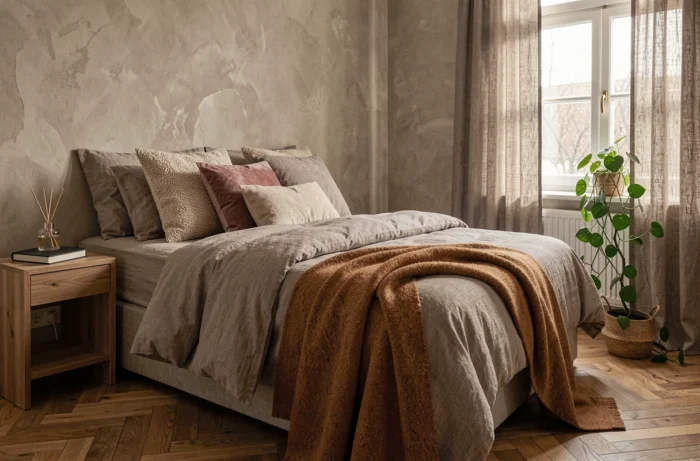
An accent wall in a terracotta, clay, or sage green tone is enough to visually warm an entire space. The empirical rule: limit strong colors to one wall or less than a quarter of the visible surface. The rest in neutral tones absorbs the saturation.
On the walls, frames and mirrors play a functional as well as decorative role. A mirror placed facing a window redistributes natural light in deep rooms. Three frames of different sizes, aligned on an imaginary horizontal line, structure a wall without overwhelming it.
A few elements to be measured with caution:
- Scented candles add an olfactory dimension, but their combustion degrades air quality if the room is poorly ventilated (back to the first point).
- Green plants slightly regulate ambient humidity and add texture. Feedback varies on their actual ability to filter pollutants, but their effect on perceived well-being is documented.
- LED string lights consume little and create a soft light without heat emission, making them usable year-round.
A warm interior is not built by piling up decorative accessories. It relies on a balance between air quality, controlled temperature, materials suited to daily use, and a few well-placed color choices. The true cocoon is one where you breathe well, sit comfortably, and where the light falls just right, even before lighting a candle.