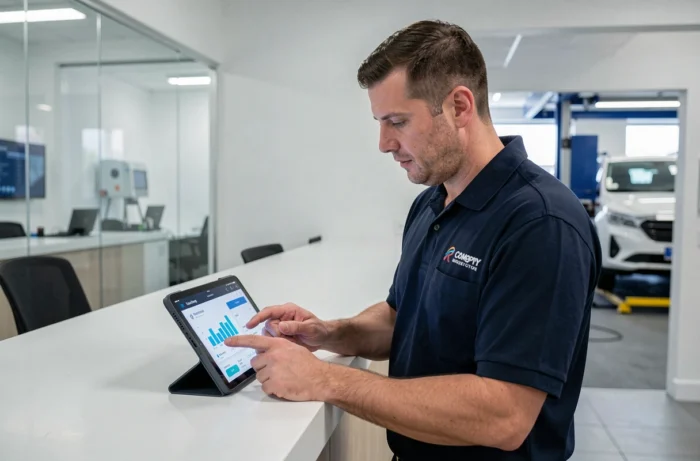
The Securitest affiliate space centralizes the daily management of technical inspection centers linked to the network. Authentication, regulatory documents, activity tracking: the platform brings together functions scattered elsewhere across several distinct tools. But what concretely distinguishes this space from competing interfaces, and which modules deserve particular attention in a rapidly changing regulatory context?
Critical failure and manufacturer recalls: what the reform changes for affiliated centers
As of January 1, 2026, vehicles subject to a manufacturer recall of the “stop drive” type are classified as automatic critical failure. The validity of the technical inspection is then limited to twenty-four hours. This measure, stemming from the decree of December 8, 2025, profoundly alters the management of re-inspections.
For an affiliated Securitest center, this means adapting internal procedures. The management software must identify ongoing recalls, trigger the correct failure classification, and generate the corresponding report within the imposed deadlines. An online space capable of relaying these regulatory updates in real-time becomes a direct operational lever, not just a simple administrative portal.
Professionals wishing to access the Securitest affiliate space will find in this interface notifications related to regulatory developments, including those concerning manufacturer recalls and new categories of failure.

Technical inspection of category L vehicles: schedule and impact on the Securitest platform
The extension of technical inspection to two-wheeled and three-wheeled motor vehicles represents a structural change for networks. The rollout, initiated in 2024, follows a progressive schedule based on the year of first registration.
| Year of registration | Year of first mandatory inspection |
|---|---|
| Before 2017 | 2024 |
| 2017 – 2019 | 2025 |
| 2020 – 2021 | 2026 |
This schedule, stemming from decree no. 2023-974 of October 23, 2023, directly concerns Securitest affiliated centers equipped to receive these categories of vehicles. Appointment slots and management of inspection lines must integrate these additional flows without disrupting existing activity.
An efficient affiliate space must therefore offer a scheduling module capable of distinguishing between inspections of conventional light vehicles and those of category L. The gradual increase in workload allows time to adjust parameters, but centers that do not prepare their organization risk congestion during peak renewal periods.
Specific technical points for two-wheelers
Initial field feedback indicates new inspection points specific to motorcycles and scooters. The control data, failure grids, and tolerance thresholds differ significantly from those applied to cars.
The online space of the network must provide inspectors with updated references for these categories. Without centralized access to technical documentation, the risk of classification errors increases during the initial months of adaptation.
Management modules and online services: comparison of common uses
The Securitest affiliate space is structured around several functional blocks. Not all centers utilize the same modules with the same intensity. Here are the most frequently used functions on a daily basis:
- Administrative and accounting management: tracking invoices, tax documents, and supporting documents related to the center’s activity, accessible from a single dashboard.
- Communication with technical support: reporting software anomalies, requests for updates, or reporting hardware malfunctions, with integrated ticket tracking.
- Access to regulatory documents: reference texts, circulars, normative updates. This module gains increased importance with successive reforms on category L and manufacturer recalls.
- Activity statistics: number of inspections carried out, re-inspection rates, distribution by vehicle type. This data allows for performance management of the center over a given period.
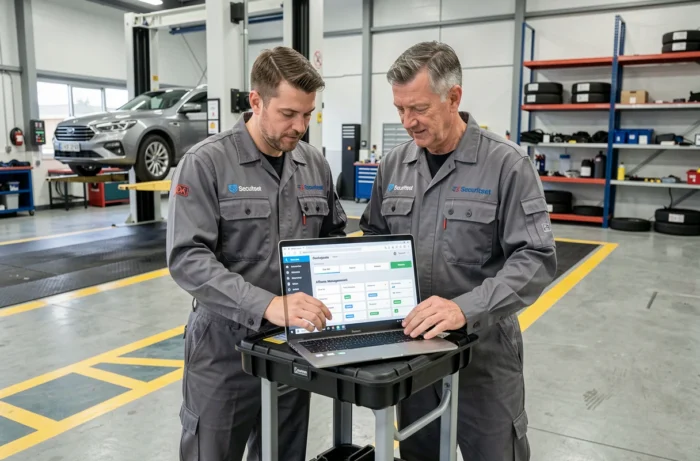
Authentication and access security
Access to the affiliate space relies on an identifier linked to the center code and a controller-level password. Each user profile has differentiated access rights based on their role in the center (manager, inspector, administrative assistant).
This compartmentalization limits the risks of unintentional manipulation of sensitive data. However, it requires rigorous management of identifiers, especially during staff turnover or changes in center codes.
Securitest network and positioning among technical inspection operators
Securitest is part of the SGS group and coexists with other brands in the same group, such as Autosécurité and Vérif’Autos. The centers affiliated with each of these networks access distinct portals but share a common technical foundation.
The advantage of a dedicated affiliate space lies in its ability to adapt tools to the specificities of each brand: visual identity, commercial processes, partner offers. For a Securitest affiliate, the online platform also serves as a channel for disseminating promotional operations and discounts offered through the network.
The centralization of activity data at the network level provides an advantage that independent centers do not have: the ability to benchmark against national or regional averages and identify performance gaps without resorting to third-party tools.
The rapid regulatory evolution, between the extension to category L and the tightening of rules on manufacturer recalls, transforms the affiliate space into a tool for compliance as well as management. Centers that fully utilize its regulatory tracking and statistics modules have a solid foundation to absorb upcoming deadlines without improvisation.