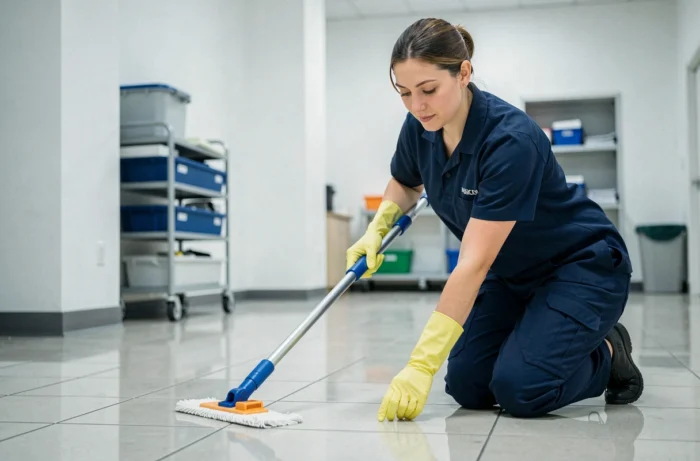
On a construction site undergoing restoration after work, a cleaning agent who does not master the dosage of an alkaline detergent can damage a floor covering in just a few minutes. This type of error, common among untrained operators, illustrates how much the professional cleaning trades require precise technical skills.
Training in professional cleaning is not just about learning to mop: it is about mastering products, safety gestures, and hygiene protocols adapted to each environment.
Accidents and musculoskeletal disorders: the real driving force behind safety training
We rarely talk about what concretely drives cleaning companies to train their teams. The cleaning services sector is among the most affected by workplace accidents and musculoskeletal disorders (MSDs). The 2024 annual report from the Health Insurance on occupational risks ranks the “Services II” branch, which includes cleaning, among those with very high accident rates.
MSDs are the leading cause of work stoppages in these professions. Repeated poor postures, lifting loads, twisting movements during mechanized washing: poorly executed technical gestures lead to chronic pathologies. That is why the “gestures and postures” modules are not an optional extra, but a foundation of any serious training in cleaning.
Training now includes practical workshops on workplace ergonomics. Some specialized organizations even offer annual refresher sessions, as habits can be quickly lost in the field. These programs can be found at organizations like those listed on the training page of Les Blancs d’Ecole, which allow for targeting specific operational skills.
Training pathways in professional cleaning: from CAP to professional title
The most common pathway to enter the profession remains the CAP Cleaning and Hygiene Agent. This level 3 diploma covers manual and mechanized cleaning techniques, the use of cleaning products, and safety rules. It is prepared over two years, often in alternating periods.
For those aiming for a quick skills upgrade, the professional title of Cleaning and Hygiene Agent awarded by the Ministry of Employment is a shorter alternative. Afpa offers this qualifying training in its centers, lasting a few months and including practical situations on technical platforms.
Beyond these two main pathways, the sector has recognized professional qualification certifications (CQP) acknowledged by the cleaning branch. They validate specific skills:
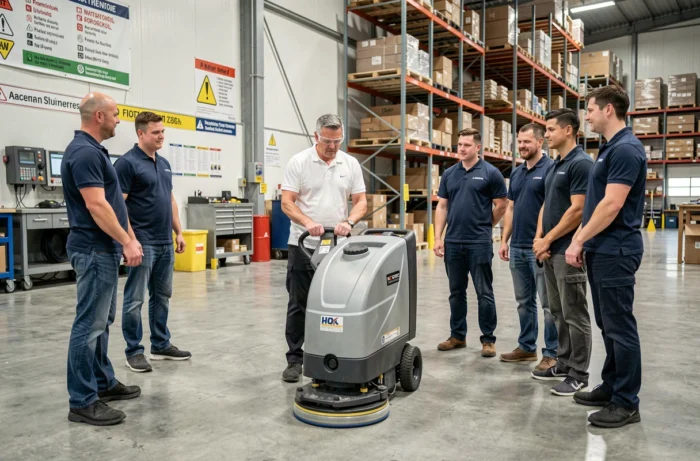
- The CQP Classic Machine Operator, focused on driving scrubbers and single-brush machines in tertiary or industrial environments
- The CQP Maintenance and Renovation Agent in Cleaning, covering restoration operations (stripping, crystallization of floors)
- The CQPs oriented towards supervision, for team leaders managing planning and quality control on site
Feedback on the recognition of these CQPs varies by region and clients, but they remain a concrete lever for negotiating a position or a salary increase.
Chemicals and disinfection protocols: what training changes on the ground
A trained agent does not choose their product at random. The distinction between detergent, disinfectant, and detergent-disinfectant determines the effectiveness of cleaning and the safety of the operator. Using an acidic product on a limestone floor without appropriate protection poses a risk of chemical burns and damage to the substrate.
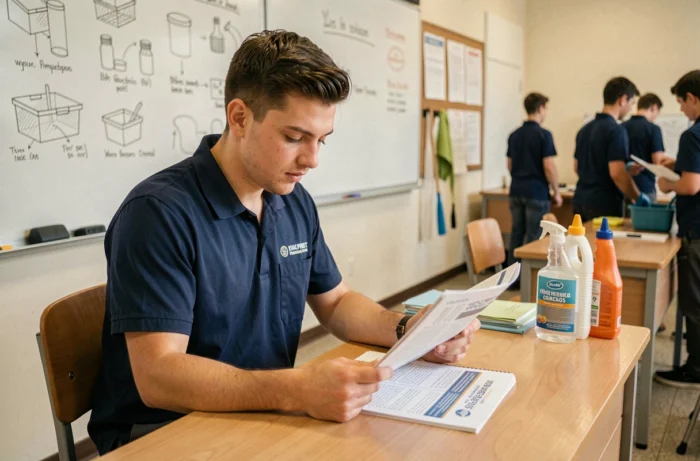
Knowing how to read a safety data sheet (SDS) is part of the basic skills taught in training. One learns to identify hazard pictograms, usage concentrations, and incompatibilities between products. This is not theoretical: on a hospital or food processing site, a dosage error can compromise a validated disinfection protocol.
Since the health crisis, the need for disinfection has increased across all sectors. Training now includes specific modules on bio-cleaning protocols, traceability of operations, and the use of personal protective equipment suitable for each family of products.
Funding for cleaning training: mobilizable schemes
The cost of training should not be a barrier. Several schemes cover all or part of the expenses, depending on the candidate’s situation:
- France Travail funds training for job seekers through individual training assistance (AIF) or regional contracts
- OPCOs (skills operators) cover training for employees in cleaning companies, including CQPs
- The personal training account (CPF) allows for financing professional titles and certain certifications listed in the RNCP
- Regional councils offer specific programs for individuals distanced from employment, often in partnership with centers like Afpa
For employees in retraining, the Transition Pro scheme (formerly Fongecif) remains available. It allows for long training while maintaining salary, provided that the project is validated by the joint commission.
Professional Bac MEPEU: a new pathway to watch
Created in 2024 and implemented starting in the 2025 school year, the professional Bac Environmental Maintenance and Urban Space Cleaning (MEPEU) opens a new pathway. This diploma combines cleaning skills with waste management, sanitation, and material recovery.
In practice, a holder of the Bac Pro MEPEU will be able to intervene in both the maintenance of premises and selective collection or maintenance of urban equipment. This versatility meets the growing demand from local authorities, which seek profiles capable of transitioning from a classic cleaning mission to an environmental intervention.
This pathway repositions cleaning professions within the framework of ecological transition, which could permanently change the attractiveness of the sector to young people in orientation.
The cleaning sector remains one of the smallest specialties in terms of the number of apprentices in France, with fewer than ten thousand entries into apprenticeship each year across all certifications. Training more and better remains a direct challenge for companies struggling to recruit qualified agents.