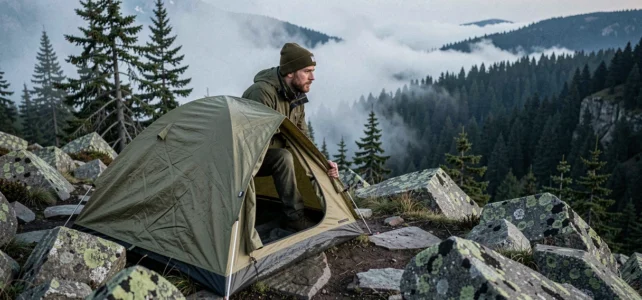
Spending a night outdoors, whether in a chosen bivouac or out of necessity, exposes the body to threats that a roof and four walls usually filter out without us thinking about it. Cold, heat, insects, unstable terrain: the dangers of sleeping outside go beyond discomfort. They affect thermoregulation, skin, sleep quality, and, by domino effect, the ability to make good decisions the following day.
Nocturnal thermal stress: the danger that never sleeps
The thermal risk is often associated with cold. In winter, heat loss through the ground indeed represents the most direct threat. Without insulation beneath the body, body temperature drops much faster than in the ambient air, because the ground conducts heat several times better than still air.
The opposite is equally concerning. The WHO reminds us that the temperature felt in the sun can be significantly higher than that of the ambient air and emphasizes the need to stay in the shade, limit activity during the hottest hours, and maintain hydration. Sleeping outside during a heatwave exposes one to dehydration and thermal stress, including at night, when the temperature does not drop below a threshold allowing the body to recover.
Understanding the dangers of sleeping outside requires taking these two extremes into account, as preventive measures differ radically depending on the season.
Against the cold, thick ground insulation matters more than the sleeping bag. A closed-cell foam mattress or a sufficiently dense ground pad prevents direct contact with the earth. Against heat, the choice of location is paramount: a ventilated spot, in the shade of a natural relief, with access to water for regular hydration during the night.
Stings, bites, and ticks: protecting the skin after the night
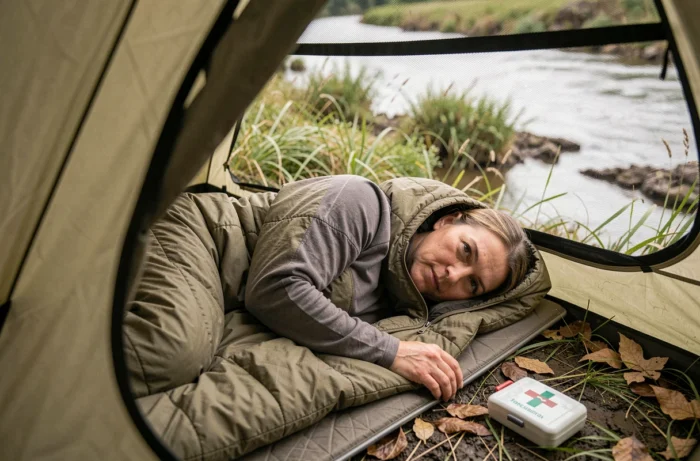
Have you ever noticed that a simple mosquito bite can ruin an entire night? Outdoors, insects are not just a noise nuisance. Some transmit pathogens, and the risk increases with the duration of exposure.
Ticks deserve special attention. They attach painlessly, often in body creases, and are only detected the next morning. The concrete prevention point is not just to avoid animals: one must cover the skin, use appropriate insect protection, and inspect the body after each night outdoors. Some risks only appear later, sometimes several days afterward.
In practical terms, prevention relies on three simple actions:
- Wear long, light-colored clothing, snug at the ankles and wrists, to limit insect access to the skin.
- Apply suitable repellent to exposed areas, renewing the application if the night is long or humid.
- Methodically inspect the entire body upon waking, paying special attention to the backs of the knees, armpits, and scalp.
Sun exposure and eye protection upon waking
Sleeping outdoors also means waking up in full sunlight. Without blinds or curtains, UV rays reach the skin and eyes at the first light. Over several consecutive days, this cumulative morning exposure can cause damage that is often underestimated.
The eyes are particularly vulnerable upon waking, when the pupils are still dilated after the night. Direct and repeated exposure to morning sunlight, especially at high altitudes or near reflective surfaces (water, sand, snow), can irritate the cornea.
Sunscreen is not just for the beach. If you sleep outside in summer, applying protection to the face and forearms as soon as you wake up reduces the risk of burns. For children, whose skin reacts more quickly, this precaution becomes non-negotiable.
Sleep debt and judgment errors outdoors
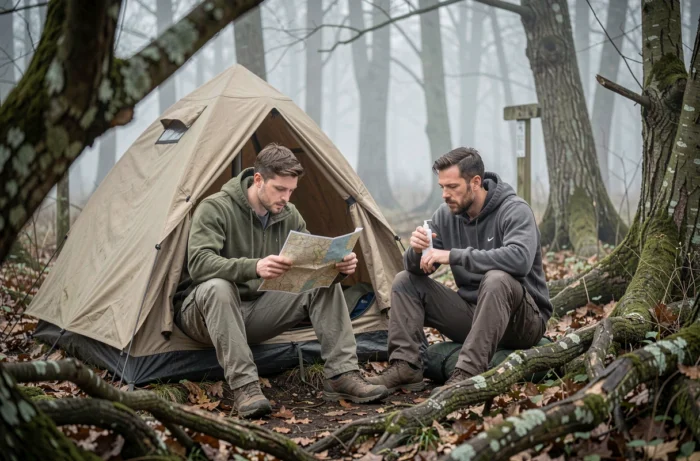
The least visible danger is also the most insidious. A night outdoors almost always results in fragmented sleep: noise, discomfort, instinctive vigilance, temperature variations. The impact remains manageable after a single night. After several consecutive nights, sleep debt accumulates.
INRS emphasizes that sleep deprivation impairs vigilance and increases the risk of errors and accidents. Prolonged wakefulness degrades performance in very concrete ways. Translated to a bivouac situation, this means that after two or three nights of poor rest, the ability to assess terrain, a route, or weather deteriorates significantly.
Some practical guidelines to limit this degradation:
- Establish a consistent bedtime routine each night (same time, same actions) to send a signal of rest to the body.
- Eat enough before the night, as digestion helps maintain body temperature and facilitates falling asleep.
- Choose a location where ambient noise is constant and low (wind in the leaves, distant flowing water) rather than a silent place where the slightest crackle wakes you.
- Accept taking a short nap during the day if the night was poor, rather than pushing fatigue until the evening.
Location and safety: a choice that conditions everything else
The ground where one sets up their bedding determines the quality of the night as much as the equipment. A gently sloping ground drains rainwater. A few meters back from a watercourse protects against a sudden rise in water level. Checking the branches above before settling takes a few seconds and can prevent an accident during the night, especially in strong winds.
Discretion also reduces risks related to human interactions. Setting up at dusk, packing up early in the morning, and leaving no trace are principles that protect against confrontation as well as checks.
Sleeping outdoors is not dangerous in itself. What is dangerous is doing so without having identified the threats specific to the location, the season, and one’s own physical condition. Prevention relies less on high-end equipment than on the attention paid to the ground beneath the back, the exposed skin, and the sleep actually obtained.