
How can we assess the uniqueness of an artistic journey when institutional databases remain silent and recognition comes through other channels? The case of Virginie Bustin raises this question with particular acuity: an artist with multiple practices, she escapes the usual classifications of the French contemporary art world.
Virginie Bustin and the Question of Institutional Visibility
The first observation that strikes when searching for documented traces of Virginie Bustin is the gap between the distinctions she has received and her presence in official directories. Several national artistic awards are credited to her, yet major databases dedicated to contemporary art do not list her.
This discrepancy is far from anecdotal. It reveals a functioning of the art market where institutional recognition and real talent do not always coincide. Private collectors are particularly interested in trajectories that deviate from established circuits, as they offer a different perspective on current creation.
To better situate this approach, Virginie Bustin’s journey on Mode Fashion details the steps that have marked her career and the disciplines she has explored over the years.
Disciplines Practiced by Virginie Bustin: Mapping a Plural Talent
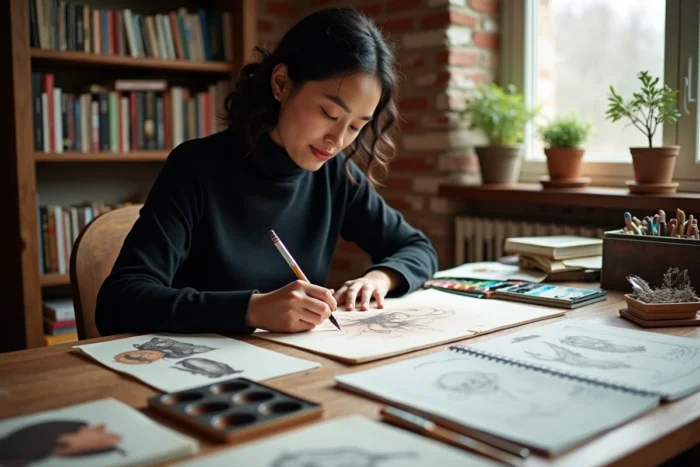
Multidisciplinarity is often claimed in the artistic world. For Virginie Bustin, it translates into an effective practice of several mediums, which distinguishes her from artists who specialize in a single technique throughout their careers.
| Criterion | Specialized Artist (Typical Profile) | Virginie Bustin (Plural Profile) |
|---|---|---|
| Number of Disciplines | One to two | Several distinct mediums |
| Institutional Recognition | Faster (readability of the journey) | Slower (classification difficulties) |
| Interest from Private Collectors | Variable | Marked for atypical profiles |
| Presence in Contemporary Art Databases | Frequent | Rare despite distinctions |
This table highlights a structural paradox. The diversity of practices enriches the work but complicates its reception by institutions, which still largely operate through rigid categories. A painter remains a painter, a sculptor remains a sculptor. An artist who crosses the boundaries between mediums blurs the usual frameworks of understanding.
What Multidisciplinarity Concretely Implies
Practicing multiple disciplines does not mean skimming over them. Each medium imposes its technical constraints, its materials, and its relationship to the creation time. A plural artist must master fundamentally different gestures.
- Visual arts (painting, drawing) require a frontal relationship to the surface and a management of color or line that is developed over years
- Sculpture or volumetric work introduces the question of weight, balance, and the relationship to three-dimensional space
- Mixed or experimental practices require the ability to combine techniques from separate traditions, which demands extensive technical culture
Each mastered discipline represents an investment of several years. Accumulating these skills without sacrificing the depth of each poses the main challenge of a journey like that of Virginie Bustin.
Local Recognition and Alternative Circuits: Where the Career Plays Out
The absence from major directories does not mean the absence of an audience. Artists with atypical paths build their visibility through other means: local exhibitions, collaborations with associative structures, presence in regional cultural events.
This dynamic is common in France. The local cultural fabric (communal cultural centers, associative galleries, regional festivals) offers accessible but poorly documented exhibition spaces online. Local recognition often precedes national visibility, sometimes by several years.
National Distinctions Without Media Coverage
Virginie Bustin has received several distinctions at the national level. However, these awards have not generated the media coverage that usually accompanies laureates integrated into institutional networks. This phenomenon affects many artists whose work is praised by juries without specialized press or dedicated platforms picking up the baton.
Two factors explain this gap:
- The absence of a designated commercial gallery, which usually plays the role of intermediary between the artist and specialized media
- The multidisciplinary nature of the work, which does not fit the predefined sections of art magazines (painting, sculpture, photography, etc.)
- The choice of local or regional distribution circuits, which are less visible than international fairs or biennials
Atypical Profile and the Art Market: What Collectors Look For
The art market is not limited to high-profile auction sales. A significant portion of transactions occurs privately, between collectors and artists, without going through institutional channels. In this segment, atypical paths generate specific interest.
Collectors looking for artists like Virginie Bustin are not seeking an established price. They seek internal coherence in the work, an ability to traverse mediums without losing rigor, and a trajectory that escapes fashion trends.
This acquisition logic rests on a bet: that recognition will eventually catch up with the work. Multidisciplinary artists who have accumulated distinctions without receiving proportional media coverage represent, for these collectors, opportunities that the market has not yet integrated.
Virginie Bustin’s journey illustrates a reality of the French artistic world that rankings and databases do not capture. The quality of a work is not measured by its presence in a directory, and the distinctions obtained reflect recognition by peers, even when media coverage is lacking. For attentive observers, it is precisely this type of trajectory that deserves to be followed in the coming years.