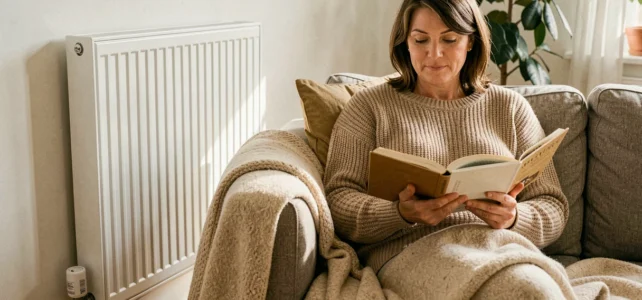
A radiator running at full power in an empty room, a boiler restarting endlessly at night, a home losing heat through the windows: heating bills often rise for very concrete reasons. Economic heating does not rely on a single miracle device, but on a set of technical choices that, when combined, sustainably reduce energy consumption.
Electricity down, gas up: adapting your heating strategy in 2025
Have you noticed that your gas bill is increasing while your electricity bill stabilizes? This is no coincidence. In 2025, the average price of electricity for French households decreases by about 9% year-on-year, while the price of natural gas increases by 8.6% over the same period, according to the Ministry of Ecological Transition.
This reversal changes the game. A home heated by gas sees its costs rise, while an efficient electric system (heat pump, inertia radiators) becomes comparatively more competitive. The trade-off between electricity and gas shapes the entire strategy for reducing bills.
Specifically, for a household equipped with an aging gas boiler, the resources available on chauffage-economique.com allow for comparing systems and assessing the real cost of changing systems. Switching to an air-water heat pump, for example, divides primary energy consumption compared to a conventional boiler, even if the initial investment remains substantial.
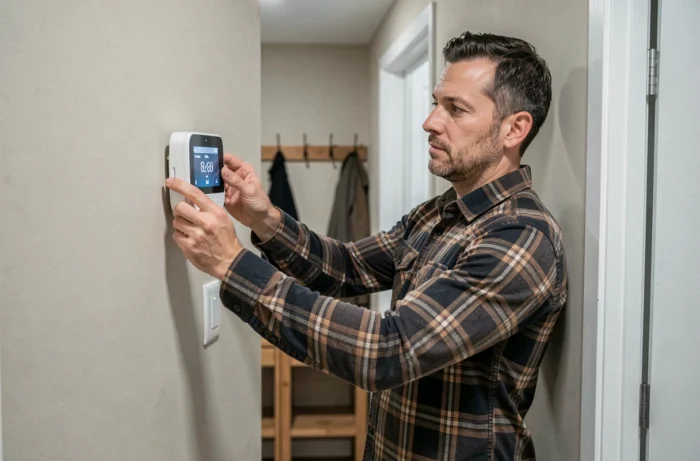
Programmable thermostat: the most cost-effective lever per euro invested
Before changing equipment, the first question to ask is simple: does your heating work when no one needs it? A programmable thermostat cuts this waste at the source.
What a programmable thermostat actually does
It adjusts the temperature according to the hours and days of the week. At night, it lowers the setpoint. During the day, when the home is empty, it maintains a minimum. The heating only restarts at full power shortly before your return.
A connected thermostat can generate up to 30% energy savings in a single-family home, according to documented feedback from home automation manufacturers. The exact savings depend on the insulation of the home and the habits of the household, but the principle remains the same: do not heat unnecessarily.
Wired, wireless, or connected: which one to choose?
Connected models sometimes detect the opening of a window or the prolonged absence of occupants to automatically turn off the heating. This level of automation justifies a modest additional cost compared to a classic wired thermostat.
- Wired thermostat: reliable and inexpensive, suitable for existing installations with a single heating circuit.
- Wireless thermostat: more flexible to install, it communicates via radio with the boiler or electric radiators.
- Connected thermostat: controllable via smartphone, it learns your habits and adjusts the temperature in real-time, even remotely.
Room-by-room temperature: the adjustment that many neglect
Heating all rooms to the same temperature is a waste of energy in less occupied spaces. The logic is simple: each additional degree increases consumption by about 7%.
The recommendations from ADEME are precise. Living areas (living room, office) should be heated to 19 °C when occupied, and drop to 16-17 °C when unoccupied. Bedrooms should be maintained around 17 °C at night. The bathroom should be heated to 22 °C only during use.
In practice, this means installing thermostatic valves on each water radiator or programming each electric radiator individually. Thermal zoning is the direct complement to the central thermostat: one sets the overall target, the other fine-tunes it room by room.
Insulation and air leaks: acting on the building envelope
An efficient heating system in a poorly insulated home is like heating the outdoors. Before investing in new equipment, check the condition of the thermal envelope.
The most common weak points
Single-glazed windows, uninsulated roller shutter boxes, and door bottoms without seals are the primary sources of heat loss. Closing shutters at night significantly reduces losses through glazing, with no effort required.
Thick curtains in front of windows create an air buffer. This is an old gesture, but it remains effective in addition to double glazing.
The energy performance diagnosis (DPE) as a priority indicator
The energy performance diagnosis (DPE) ranks homes from A to G. Homes rated G have been banned from rental since January 2025, and those rated F will be banned starting in 2028. This regulatory constraint pushes owners to renovate, but it also serves as a benchmark for any occupant: a poor DPE indicates significant losses and a high potential for savings after renovations.
Energy poverty: when lowering the thermostat is no longer enough
Advice on setpoint temperature or programmable thermostats assumes a properly insulated home and functioning equipment. For an increasing number of households, this foundation is not guaranteed.
The National Observatory of Energy Poverty (ONPE) indicates that in 2024, about 1.2 million households experienced an energy cut or a reduction in power, representing an increase of about 24% in one year. Furthermore, 35% of French people reported feeling cold in their homes during the winter of 2024-2025.
Reducing bills should not come at the expense of minimum thermal comfort. For these households, the priority is access to renovation aids (MaPrimeRénov’, energy savings certificates) rather than purchasing a connected thermostat. Insulating attics or replacing an outdated boiler has a much more significant effect than behavioral adjustments in a leaky home.
Choosing economic heating means first understanding where energy is going in your own home. The DPE provides an initial assessment, the thermostat limits daily waste, and the price changes between electricity and gas guide the long-term choice of system. The bill decreases when these three levers work together.