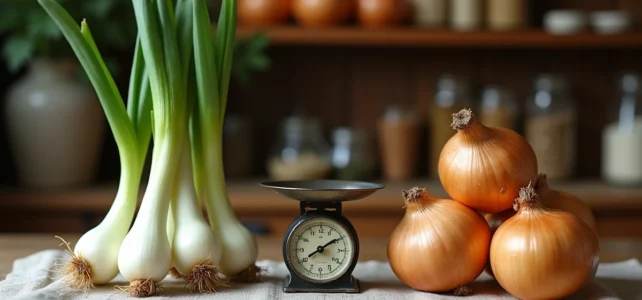
A new onion weighs on average 40 g (bulb only), compared to three to four times more for a medium-sized dry onion. This difference is not due to the variety: it is the stage of harvest and drying that modify the density, water content, and thus the final weight of the bulb. Understanding what separates these two forms of the same vegetable helps avoid recurring dosage errors in cooking.
Water content and drying: what affects an onion’s weight
The new onion (Allium cepa) is harvested before it reaches full maturity. Its bulb has not undergone a drying process, which gives it a significantly higher water content than that of the dry onion. Paradoxically, this water does not make it heavier: the bulb simply hasn’t had the time to develop as much as that of a storage onion.
The dry onion, on the other hand, is left in the ground until the tops fall over and dry naturally. It then goes through a controlled drying phase (curing) that reduces external moisture. Its skin becomes parchment-like, protective, and the bulb concentrates in dry matter. This process allows it to be stored for several months, while a new onion barely lasts a week in the refrigerator.
To properly compare these two onions, one must consider both the maturity of the bulb at the time of harvest and the post-harvest treatment. A 40 g new onion and a 150 g dry onion do not represent the same amount of usable flesh, nor the same aromatic intensity.
An article detailing the average weight of an onion according to its form helps to better understand these discrepancies before applying them in cooking.

Commercial size of dry onions and weight of new bulbs
Dry onions sold in nets or bulk meet specific sizing standards imposed by distribution channels. Categories are generally distinguished by diameter (for example, 40-60 mm, 60-80 mm), which ensures visual uniformity on the shelf. A yellow dry onion of size 60-80 mm corresponds to the most common format in French supermarkets.
The new onion, sold in bunches at markets or in the fresh section, does not follow the same sizing requirements. Bunches often group five to eight small bulbs with their green tops. Standardization is less strict, which explains a greater variability in weight from one bulb to another.
Why size alone is not enough to compare the two
Comparing a dry onion sized 60-80 mm to a new onion sold in a bunch is akin to paralleling two products whose sorting criteria differ. The former is selected based on the bulb’s diameter, while the latter is based on the presentation of the entire bunch (tops included). The weight of a bunch of new onions includes the tops, which represent a significant portion of the total weight without equating to usable onion flesh in a classic recipe.
In practical terms, a bunch weighing 300 to 500 g may contain only 200 to 300 g of actual bulbs, equivalent to two medium dry onions in terms of flesh volume. Ignoring this distinction leads to under-dosing or over-dosing depending on the type of onion used.
New onion versus dry onion in cooking: adjusting the dosage
The weight difference between new onions and dry onions has a direct impact on recipe dosage. Replacing a medium dry onion with a single new onion without adjusting the quantity will yield a result that is too bland, as two to three new onion bulbs are equivalent to one medium dry onion in terms of mass and aromatic strength.
- A new onion brings a sweet flavor and a melting texture, suitable for salads, omelets, and quick cooking. Its unit weight (bulb only) is around 40 g.
- A medium dry onion weighs significantly more and develops more concentrated aromas when cooked, making it suitable for stews, soups, and sauce bases.
- The green tops of the new onion, edible, can be used like chives or scallions. They add visual volume to a dish without significantly altering the weight of usable onion in the aromatic base.
For a recipe that calls for “an onion,” it almost always refers to a medium dry onion. If you wish to substitute with new onions, multiply the number of bulbs by two or three depending on their size.
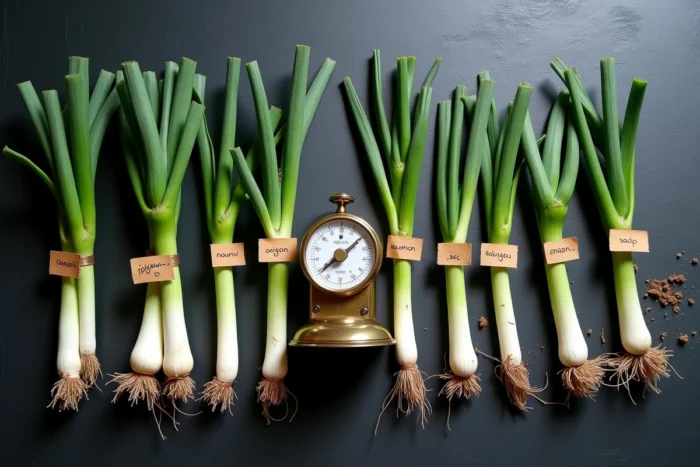
Weight and nutritional values: how the type of onion changes things
At equal weight, the nutritional composition of new onions and dry onions remains similar. Both provide vitamin C, fiber, and sulfur compounds characteristic of the Allium genus. The difference lies in the amount actually consumed per serving.
Since a medium dry onion weighs several times more than a new onion bulb, a standard serving of dry onion mechanically provides more micronutrients than a single new bulb. The green tops of the new onion partially compensate for this gap by providing carotenoids and vitamin K, which are absent from the dry bulb part.
Summary table of key differences
| Criterion | New Onion | Dry Onion |
|---|---|---|
| Average bulb weight | About 40 g | Significantly higher (variable size) |
| Tops | Edible, included in the selling weight | Absent (removed before drying) |
| Water content | Very high | Reduced by the drying process |
| Storage | Few days in the refrigerator | Several months at room temperature |
| Commercial sizing | By bunch, little standardized | By bulb diameter, standardized |
| Recipe equivalence | 2-3 bulbs to replace 1 medium dry onion | 1 onion = standard dose |
The next time a recipe mentions “an onion” without further specification, it defaults to a medium dry onion. For new onions, count in bulbs and weigh if precision matters. And keep the tops: they are worth it in a salad or as a finishing touch to a hot dish.