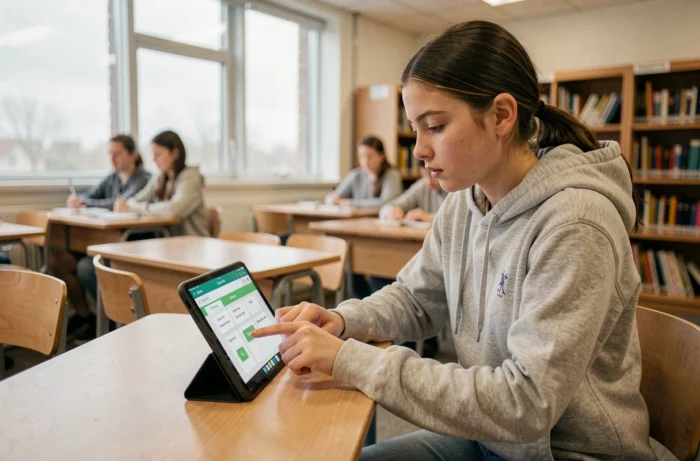
A fourth-grade student struggling with a geometry exercise at 9 PM on a Tuesday night does not have access to their teacher. They open a tutoring platform, rephrase their question, and receive a step-by-step explanation tailored to their level.
This scenario, commonplace in many households, relies on technological bricks that did not exist in this form five years ago. The transformation of schooling through digital services is not just about replacing paper with a screen: it changes the way we learn, how we communicate between school and family, and how teachers adjust their pedagogy.
National Framework for AI in Schools: What the Texts Really Allow
Since June 2025, the National Education has a formalized national framework for the use of artificial intelligence in schools. This framework clearly distinguishes what is possible according to the student’s level.
In primary school, children can be made aware of how AI works, but they cannot directly manipulate generative tools that produce text or images. The idea is to limit younger children’s exposure to interfaces whose biases they do not understand.
Starting from the fourth grade, the pedagogical use of generative AI becomes possible, provided it is strictly supervised by the teacher and linked to a specific educational objective. We are not talking about letting a teenager freely chat with a chatbot: the teacher defines the scope, chooses the tool, and integrates the session into their progression.
This distinction by school level changes the game for educational service providers. Those offering generative AI features must now plan differentiated modes, with enhanced filters for the first degree. For families looking to support their children’s education, Pop Shot’s innovative services illustrate this logic of tools designed to adapt to each student’s journey.

ENT and School-Family Communication: Massive Use, Concrete Limits
Digital work environments (ENT) have established themselves as the main communication channel between schools and parents. Almost all public high schools, the vast majority of middle schools, and a growing number of primary schools offer an ENT. The IGESR qualifies them as “necessary for communication with families.”
On the ground, the observation is more nuanced. The proliferation of tools creates a coherence problem: a parent may juggle between the official ENT, a third-party school life application, the school’s messaging system, and an informal discussion group. Feedback on this point varies, as fluidity depends heavily on the institution and the willingness of the teaching team to centralize exchanges.
The other blind spot concerns parents who are distanced from digital technology. Institutional responses are still deemed insufficient for this audience. An innovative service only has a real impact if it is accessible to families who need it most, not just to those already comfortable with digital tools.
What ENTs Change in Practice for Academic Monitoring
- Real-time access to grades, absences, and the homework diary, which reduces the gap between an incident in class and the information communicated to parents.
- The possibility for the teacher to share additional resources (videos, interactive exercises) directly in the course space, without going through a paper medium.
- Integrated messaging that gradually replaces notes in the communication notebook, with a history that can be consulted by both parties.
Adaptive Learning: When the Tool Adjusts the Path in Real Time
The principle of adaptive learning is simple: instead of offering the same exercise to the whole class, the platform analyzes each student’s responses and adjusts the difficulty or type of content accordingly. A student who masters fractions goes directly to equations, while another receives targeted consolidation exercises.
This mechanism relies on algorithms that identify gaps based on recurring errors. The teacher receives a dashboard that indicates, for each student, the skills acquired and those that pose problems. We move from a one-time assessment (the end-of-chapter test) to a continuous and individualized diagnosis.

The educational interest is twofold. For the student, frustration decreases: they work at their own pace, without being held back or left behind. For the teacher, the time saved in identifying difficulties can be reinvested in human support, small group explanations, or collaborative projects.
Limits to Keep in Mind
An adaptive tool is not a substitute for the teacher. It excels in closed-response exercises (mathematics, grammar, languages) but remains limited when it comes to argumentation, writing, or oral expression. Technology complements pedagogical work; it does not replace it.
The issue of students’ personal data is also a pressing concern. Platforms collect detailed information on performance, response times, and connection habits. The GDPR framework applies, but vigilance from institutions and families remains necessary to verify what each service actually does with the collected data.
Training Teachers in Educational Technology: The Often Underestimated Link
One can deploy the best digital tools in an institution: without solid training for teachers, the impact remains marginal. Certification of teachers’ digital skills exists, but transitioning from a technical skill (knowing how to use software) to a pedagogical skill (knowing how to integrate a tool into a learning sequence) takes time and support.
Teachers who make the best use of innovative services are generally those who benefit from peer support: sharing practices, co-constructing sequences, and concrete feedback. Continuous training among colleagues produces more lasting results than a one-off training day.
Educational digital services truly transform schooling when three conditions converge: a clear regulatory framework (the one established in June 2025 for AI), tools that adapt to each student’s level, and trained teachers who can integrate them judiciously. The rest is just marketing.