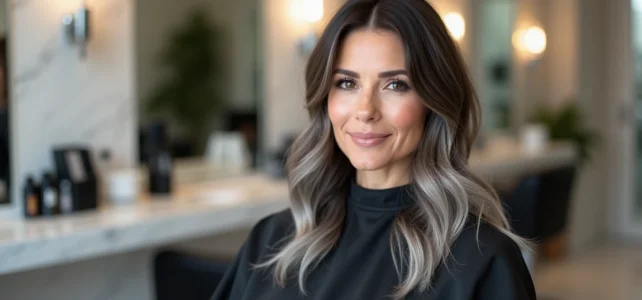
Grey blending refers to a balayage technique that blends emerging white hair into the colored mass without completely covering it. On a brown base, the contrast between the white regrowth and the dark lengths presents a specific problem: the demarcation is more visible, faster, and harder to blur than on a blonde or light brown base. The technique relies on partial and targeted lightening that reduces this tonal gap to create a gradual fade.
Placement of highlights on brown hair: the logic of localized contrast
On brown hair, grey blending does not work like a classic balayage spread across the entire head. Hairdressers who master this technique mainly work on the parting area and the contour of the face, where the first white hairs most often appear.
The highlights are finer and concentrated on the upper third of the hair. The lengths remain relatively discreet, without overall lightening. The goal is not to change the base color, but to create a localized light effect around the face.
This targeted approach distinguishes grey blending from traditional balayage, which aims for uniform lightening. Here, each strand has a specific function: to soften the contrast between a white hair and a dark brown hair, without altering the overall color. To better understand grey blending for brunettes, one must first grasp that success depends as much on hair diagnosis as on technical execution.
Hair diagnosis before grey blending: what determines the result
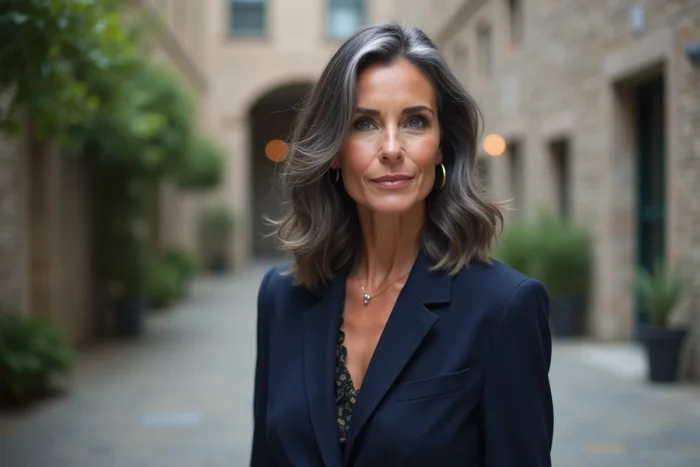
Recent professional discourse highlights a point often underestimated: the prior diagnosis is as important as the technique itself. The density of white hair, its distribution on the scalp, the color history, and the hair texture determine the protocol.
A brown hair that has already been treated with repeated colorings does not react the same way as virgin hair. Accumulated pigments can hinder lightening or produce undesirable reflections (orange, copper). The hairdresser must assess the hair’s porosity and residual pigment load before choosing the level of decolorization.
The particular case of henna
A history of henna radically changes the situation. Henna creates a sheath around the hair that resists conventional lightening products. The result can turn green or red depending on the case. Any recent application of henna must be reported to the hairdresser, or it may compromise the grey blending.
Proportion of white hair and timing
Grey blending makes the most sense when the white roots are already well visible. With only a few scattered white hairs, the lightening may seem unnecessary. Conversely, a hair that is already predominantly white does not need transitional highlights: the natural color does the job already.
The ideal moment is between these two extremes, when the white regrowth creates a clear demarcation line with the colored brown lengths.
Grey blending as a gradual transition: a process over several appointments
Grey blending is not a transformation in a single session. Recent hairdresser content emphasizes this aspect: it is a process over several months, with adjustments at each appointment.
At the first appointment, the hairdresser places the transitional highlights to break the most visible contrast. At subsequent appointments, the work evolves according to the regrowth. The highlights can be refined, moved, or spaced according to the speed at which the white hair progresses.
- First appointment: complete diagnosis, placement of the first highlights around the face and parting, assessment of the hair’s reaction
- Second appointment (usually a few weeks later): adjustment of tones, possible extension of highlights towards the sides or nape
- Maintenance appointment: gradual spacing of sessions, targeted touch-ups in areas where the contrast reappears
This transition logic changes the relationship to coloring. Instead of systematically covering every white root, grey blending accompanies natural growth by making the coexistence of the two colors harmonious.
Maintenance of grey blending on brown hair: care and frequency
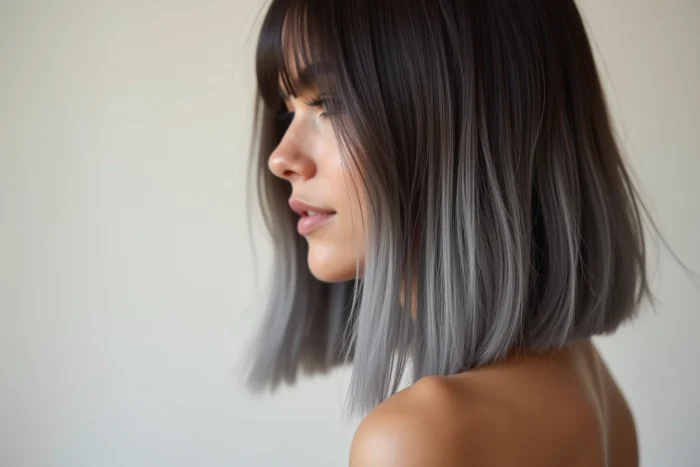
One of the most frequent arguments in favor of grey blending is the reduced maintenance frequency compared to classic coloring. On brown hair, a covering color requires a salon visit every three to four weeks to mask regrowth. Grey blending significantly spaces out these visits.
The lightened strands do not create a sharp demarcation line as they grow out. The initial fade remains visible longer, allowing for a longer wait between sessions.
Appropriate hair care
The lightened strands on a brown base undergo a partial decolorization process. The hair loses some of its natural lipids and becomes more porous.
- A sulfate-free shampoo limits dryness and preserves the obtained reflections
- A purple shampoo or silver mask used occasionally prevents the highlights from turning yellow
- A moisturizing mask applied once a week compensates for the loss of flexibility due to lightening
- Heat protection before any blow-drying or straightening reduces breakage on weakened strands
Lightened strands on brown hair require more attention than on naturally light bases, as the treated pigmentation gap is wider. The hair has undergone a deeper chemical transformation.
Grey blending on a brown base remains a partial coloring technique. The reduction in maintenance is real, but it does not mean zero maintenance. A follow-up in the salon every two to three months, combined with targeted home care, maintains the result over time without falling back into the cycle of monthly covering coloring.