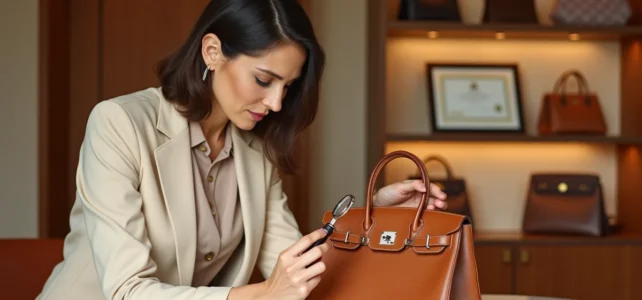
A second-hand Hermès bag is not just a simple pre-owned fashion item. In the secondary market, a Birkin or a Kelly functions as an asset whose value depends on specific criteria: model, type of leather, color, condition, and traceability.
According to the Hermès Investment Report 2026 by SACLÀB, the average resale price of a Birkin or a Kelly reaches around 16,290 euros by mid-2026. Understanding what justifies this price and what weakens it is essential for any rational purchase.
Value trajectory according to leather and Hermès model
Not all Hermès bags resell at the same price, and not all appreciate in value in the same way. The leather used weighs as much as the model in the equation.
Pieces made of exotic leathers (Porosus crocodile, alligator, lizard) experienced an annual increase of 11.5% in 2025, with an average resale value around 42,640 euros at SACLÀB in 2026. In comparison, a Birkin in Togo or Epsom trades significantly below this threshold.
Before seeking to acquire an authentic Hermès bag in the secondary market, it is necessary to identify the model-leather-color combination that offers the best liquidity. A classic color (black, gold, taupe) in grained leather resells more easily than a seasonal shade in smooth leather, even if the latter may seem rarer.
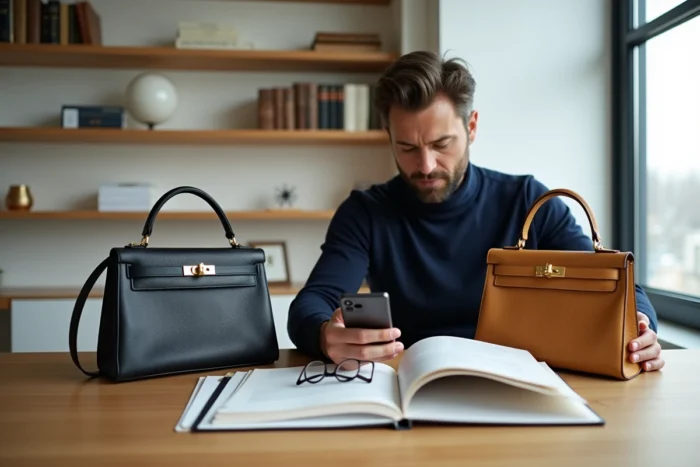
Collector Square documented a 62% increase in the average price of Birkin bags between 2016 and 2021. This progression shows that buying second-hand is as much an investment as it is a pleasure purchase, provided one targets references that have structurally strong demand.
Reading the interior marking to date a Hermès bag
The date code is a discreet embossed stamp located inside the bag. It allows for reasonably precise identification of the year of manufacture and serves as a first filter before any in-depth expertise.
Hermès introduced this system in the mid-1940s. The format has evolved several times:
- From 1945 to 1970, the year is represented by a single letter, without a frame.
- From 1971 to 1996, the letter is enclosed in a circle. From 1997 to 2014, it appears in a square.
- Since 2015, Hermès uses a new alphanumeric format (a letter followed by numbers and letters) without any geometric shape around it.
A bag without a date stamp is either older than 1945 or suspicious. In any case, a date code consistent with the condition of the leather and hardware enhances the credibility of the piece. A glaring discrepancy between visible wear and the stated date should raise alarms.
Physical checkpoints before buying second-hand
Authentication does not rely on a single indicator. It combines several cross-checks, and it is their overall consistency that determines the outcome.
The saddle stitch
Hermès uses the saddle stitch technique, performed by hand with two needles and waxed linen thread. The stitches are slightly angled and regular, but not mechanically perfect. A stitch that is too straight, too tight, or machine-made disqualifies the piece.
The hardware and logo
The clasps, locks, and bells are made of solid metal (palladium or gold-plated depending on the finishes). The “Hermès-Paris” logo is engraved clearly, without smudging or paint filling. On counterfeits, the engraving often lacks depth or shows irregularities visible under magnification.
The leather and its finishes
The edge of the leather (the slice) is dyed and polished with wax, never painted or laminated. The smell of leather, although subjective, remains an indicator: imitations often use synthetic materials with a recognizable chemical odor.
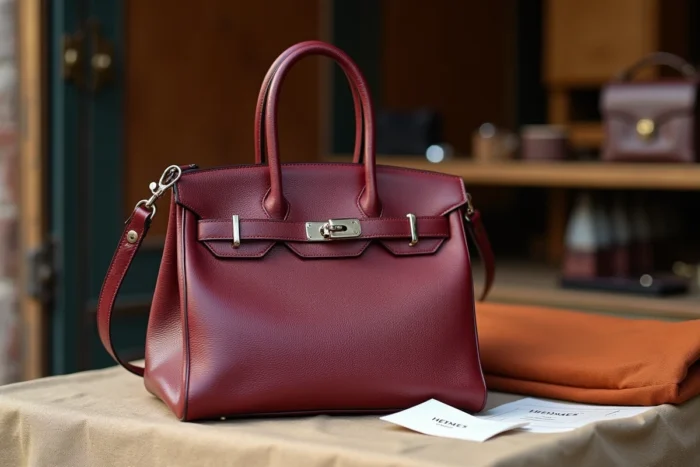
Choosing a reliable resale platform for an Hermès bag
The purchasing channel largely determines the level of risk. Three types of sellers coexist in the secondary market, with very unequal guarantees.
- Auction houses (Christie’s, Sotheby’s, Artcurial, Millon) offer prior expertise and a regulated legal framework. The final price includes buyer’s fees, but traceability is documented.
- Specialized platforms (SACLÀB, Collector Square, Vestiaire Collective) employ in-house or partnered experts to authenticate each piece before sale. Their contractual responsibility provides recourse in case of disputes.
- Private sales (social networks, classifieds) offer no structural guarantees. The risk of counterfeiting is highest here, and legal recourse is limited.
An authenticity certificate issued by an independent third party does not replace physical expertise, but it serves as a useful document for future resale. Some platforms provide it systematically, others upon request.
Taxation and traceability in the luxury secondary market
Buying a second-hand Hermès bag falls within an increasingly defined regulatory framework. Professionals in the resale of luxury goods are now subject to enhanced obligations regarding anti-money laundering, which implies more rigorous documentation of transactions.
For the buyer, this means that a detailed invoice, an authenticity certificate, and proof of provenance are no longer just bonuses. They are elements that secure the transaction and facilitate any potential future resale, especially at auction where the traceability of the lot conditions the estimate.
The Hermès secondary market is professionalizing. Buyers who document their acquisitions with as much rigor as an art collector protect both their investment and their ability to resell under good conditions.