Fashion trends refer to the stylistic directions adopted by designers during fashion weeks and later picked up by ready-to-wear collections. They manifest through choices of colors, cuts, and materials that refresh wardrobes each season. Understanding these trends helps to discern what is worth investing in versus what will become a forgotten gadget in a few months.
Fashion Regulation 2026: What Changes for Brands and Consumers
Since spring-summer 2026, two European regulations have altered the way brands design, communicate, and sell their collections. These rules have a direct impact on the availability of products in stores and online.
The European Directive (EU) 2024/825, effective from September 27, 2026, prohibits generic environmental claims on labels and product sheets. Terms like “eco-friendly,” “green,” “sustainable,” or “carbon neutral” become illegal without proof covering the entire lifecycle of the garment. Visuals (green leaves, “eco” icons) are also affected: only recognized type I labels or documented lifecycle analyses remain permitted.
In practical terms, this means that collections labeled “eco-responsible” without verifiable data will disappear from shelves. To choose a garment truly produced under better conditions, one must now look for fashion advice on Niraj Web or check for the presence of a certified label rather than relying on a marketing slogan.
The regulation (EU) 2024/1781 on the eco-design of sustainable products (ESPR) adds an additional constraint. Since July 19, 2026, large companies can no longer destroy their unsold textiles (clothing, accessories, shoes). Landfilling and shredding are prohibited except in very limited cases (counterfeits, hazardous products). Brands must prioritize donation, reuse, or repackaging.
The concrete effect for consumers: more end-of-line items accessible through second-hand channels or private sales, and pressure on brands to fine-tune their production volumes.

Colors and Materials: The Stylistic Directions of the Season
The spring-summer 2026 fashion shows highlighted red, leather, and short cuts. Pink remains a strong color, ranging from pastel to fuchsia depending on the houses. These chromatic orientations appear in ready-to-wear with a few months’ delay.
Leather, worn as a bustier, short jacket, or pants, endures through the seasons without weakening. The difference this year lies in its pairing with softer pieces: a leather bustier over wide pants, for example, creates a contrast of textures that structures the silhouette without stiffening it.
Identifying Colors That Last Beyond a Season
Not all trendy colors have the same lifespan in a wardrobe. A simple criterion helps to sort them:
- Revisited neutral colors (beige, off-white, navy blue in gradient) can be worn over several seasons and integrate into varied outfits without coordination effort
- Saturated colors like bright red or butter yellow provide a strong visual impact but require complementary understated pieces to avoid fatigue
- Pastel shades (powder pink, lilac) work well in spring and summer but lose relevance by autumn, limiting their profitability in a restricted wardrobe
Before investing in a colored piece, the question to ask is simple: how many bottoms or tops already in the closet does this color work with?
Building a Personal Style Without Following Every Micro-Trend
Fashion trends serve as a source of inspiration, not a program to be applied in full. A coherent personal style relies on a core of stable pieces to which a seasonal element is occasionally added.
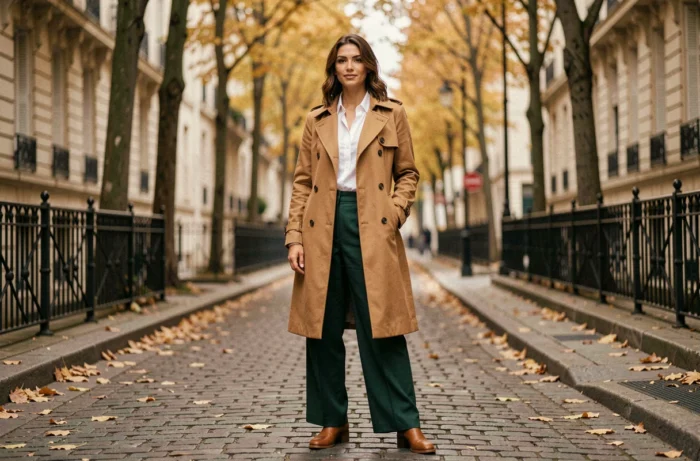
The basic wardrobe remains the best investment. A well-cut pair of jeans (barrel or straight depending on body type), a trench coat, a pair of leather shoes, and a few solid tops form a foundation upon which any trend can be grafted without destabilizing the whole.
Integrating a Trend Without Redoing Your Entire Wardrobe
The classic pitfall is to buy a complete outfit “in trend” that forms a block impossible to separate. The more effective method:
- Choose one strong piece per season (a colorful short jacket, an oversized sweater, a leather accessory) and wear it with existing basics
- Favor pieces whose cut is similar to what you already wear, changing only the color or material
- Test the trend through accessories (bag, belt, scarf) before committing a budget to a main garment
Autumn-Winter Patterns and Prints: What Lies Ahead
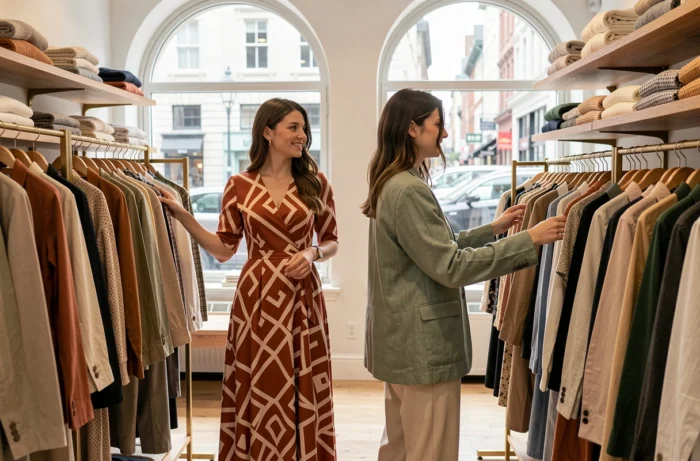
The fashion weeks in Paris and Milan for autumn-winter are already guiding upcoming choices. Geometric patterns and checks are returning in large formats, while floral prints are appearing on dark backgrounds to adapt to the cold season.
The technical point to remember: a large pattern visually enlarges the silhouette, a fine pattern structures it. This simple principle guides the choice of a print better than any trend injunction. A fine check shirt worn under a solid blazer gives a very different result than the same shirt in an oversized version with an XXL check.
Styles evolve quickly, but the logic of building a wardrobe remains constant. Investing in pieces whose cut and color serve multiple outfits protects against impulsive purchases. The European regulation is also pushing in this direction: less product volume, more reuse, and finally verifiable marketing claims.