
The portal id.ac-versailles.fr is based on a SSO (Single Sign-On) authentication system that centralizes access to Arena, IProf, and academic messaging. Since the end of 2024, the Academy of Versailles has initiated a gradual rollout of multi-factor authentication for these services, with a large-scale deployment schedule planned until 2026. Understanding the technical mechanisms behind this evolution allows for anticipating changes and adapting practices now.
TOTP Protocol and Token Expiration on id.ac Versailles
The second factor offered on id.ac-versailles.fr relies on a one-time password (OTP) token, generated according to the TOTP (Time-based One-Time Password) protocol. This temporary code, distinct from the main password, changes every few dozen seconds.
The server compares the entered code with the one calculated server-side from a shared secret and the timestamp. If the user’s device clock drifts (misaligned phone, cached browser), the code is rejected even if it has just been copied. This time discrepancy is the primary cause of reported blocks on mobile connections to Arena.
For the mechanism to work, the authentication app (Microsoft Authenticator, FreeOTP, Google Authenticator) must use the same time reference as the academic server. Checking the automatic time synchronization on your smartphone before each entry eliminates most validation failures. A detailed guide allows you to secure authentication on id.ac Versailles while considering these technical constraints.

Widespread MFA on Arena and IProf: Academic Calendar 2025-2026
The Academy of Versailles has made MFA mandatory on certain IProf and Arena modules since the end of 2024. The next phase, scheduled for 2025-2026, extends this requirement to academic webmail, with the removal of external redirects and tightening of IMAP/SMTP protocols to TLS and OAuth2.
This trajectory goes beyond simply adding a second factor. The transition to OAuth2 for mail clients replaces clear-text password authentication on messaging protocols. In practical terms, software like Thunderbird or Outlook will need to be configured to use an OAuth2 token instead of the username/password pair stored locally.
Staff using old mail clients or legacy IMAP configurations will need to update their settings. Without this update, access to Versailles webmail will be denied once the switch is made.
What This Deployment Changes for Everyday Users
- Each new session on Arena or IProf will require a TOTP code or a push validation, including from a workstation on campus
- Redirects to third-party login pages will be removed, reducing the phishing attack surface
- Passwords will need to meet enhanced complexity criteria (increased minimum length, prohibition of reusing old passwords)
Robust Password Compatible with Frequent Inputs on id.ac Versailles
A long and complex password loses its utility if it drives the user to use a sticky note or store it in an unencrypted text file. The passphrase remains the best compromise between strength and memorization for daily academic use.
A passphrase of four to five words with no logical connection between them (for example, a sequence of random common nouns separated by a special character) offers greater entropy than an eight-character password mixing uppercase letters and symbols. It is faster to type and easier to remember.
Password Manager and Academic Environment
On a shared workstation in the teachers’ lounge, a locally installed password manager poses a security issue: the database remains accessible to the next user if the session is not locked. Favoring a manager with biometric unlocking on personal devices circumvents this risk.
On a fixed workstation at the institution, the best option remains manual entry of the passphrase combined with the TOTP code. No password should be stored in the browser of a shared computer.
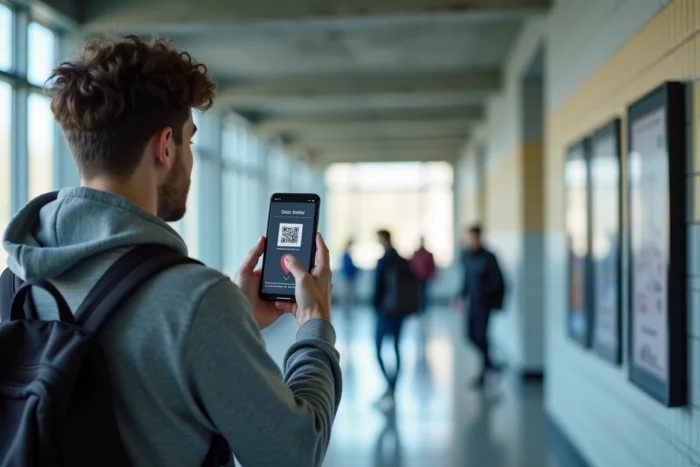
Targeted Phishing on Academic Portals: Recognizing Attacks in 2026
Phishing campaigns targeting academic accounts replicate the login page of id.ac-versailles.fr with increasing fidelity. MFA reduces the risk but does not eliminate it: adversary-in-the-middle techniques intercept the TOTP token in real-time, between the user’s input and the legitimate server.
Two technical reflexes can help thwart these attacks:
- Always check that the URL displayed in the address bar starts exactly with https://id.ac-versailles.fr, without spelling variants or unusual subdomains
- Never click on a login link received via academic email: access the portal by typing the address manually or through a saved bookmark
- Enable push notifications rather than manually entering the TOTP code when the academy offers it, as the notification displays the IP address and location of the login attempt
Academic phishing often exploits back-to-school or transfer periods when new staff discover their credentials. The first logins are the most vulnerable because the user is not yet familiar with the legitimate interface and does not notice visual differences.
Session Security and Shared Terminals in Institutions
The lifespan of an SSO session on id.ac-versailles.fr determines how long a user remains logged in without re-entering their credentials. On a personal device, a long session enhances comfort. On a shared workstation, it creates a vulnerability.
Closing the tab is not enough to destroy the session. The session cookie persists until expiration or explicit deletion. Logging out via the dedicated button on the portal is the only reliable method to invalidate the token server-side.
On institution workstations, configuring the browser to automatically delete cookies upon closing adds a layer of protection. This measure does not replace manual logout but limits damage in case of forgetfulness.
The arrival of widespread MFA across all academic services in Versailles makes these session precautions even more relevant: a stolen TOTP token is only valuable during its validity window, but an active session cookie provides full access without a second factor until it expires.